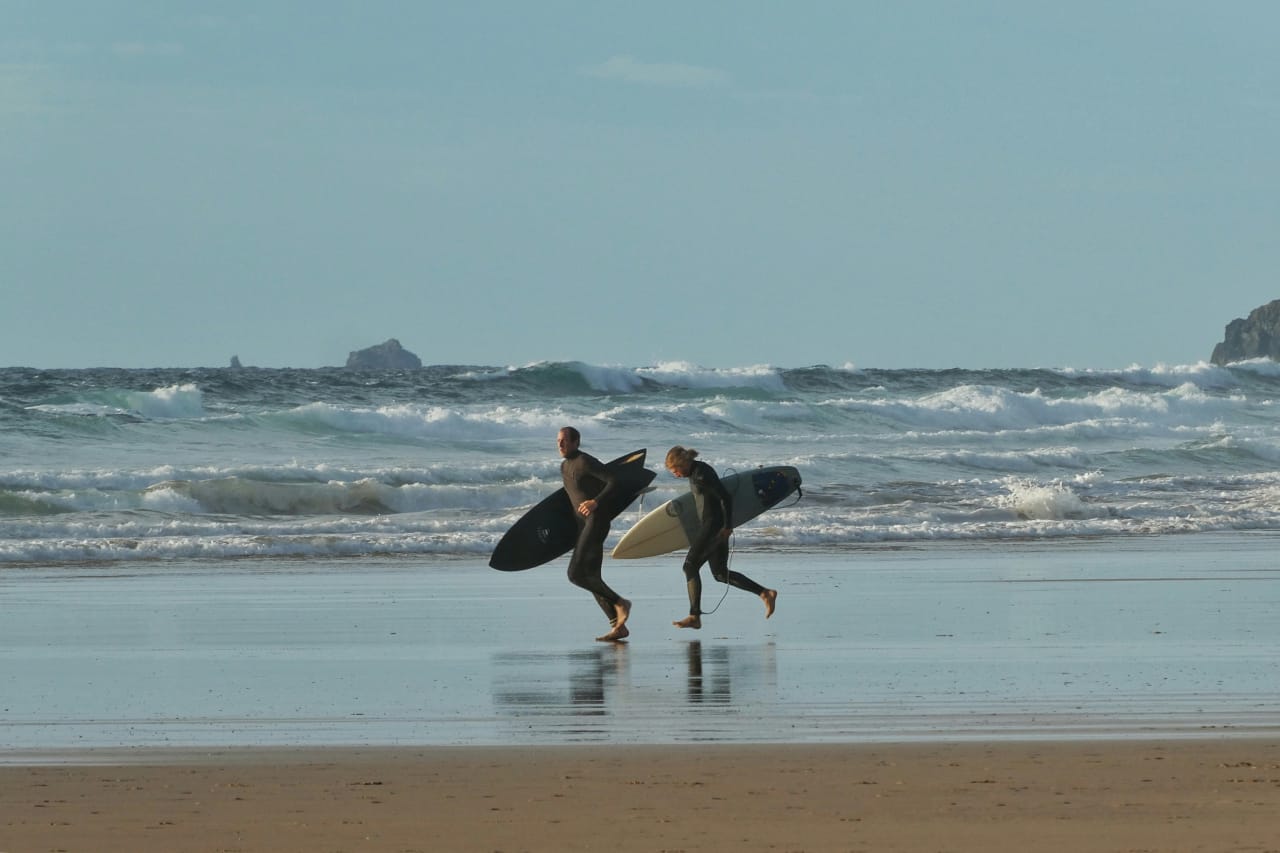
Newquay's beaches aren't scattered — they're strung along one continuous stretch of the South West Coast Path, each one within sight or a short clifftop walk of the next. Starting at Bedruthan Steps in the north and finishing at Holywell Bay in the south, here's what to expect at each one, roughly in the order you'd meet them walking the path.
Bedruthan Steps
The dramatic starting point if you're coming from further north: a run of jagged rock stacks below towering cliffs, owned by the National Trust. The steps down to the sand have a history of closures after cliff falls, so treat this as a clifftop viewpoint rather than a guaranteed beach — check the National Trust's own page above for current access before planning to walk down.
Mawgan Porth
A wide, sandy family beach backed by dunes and a small stream, with the village and its cafés right behind it. Gently sloping and reasonably sheltered, it's one of the more relaxed spots on this stretch, and dog-friendly for most of the year outside the summer restrictions.
Watergate Bay
Two miles of open sand, big enough that it rarely feels crowded even in August. Consistent swell and space to spread out have made it a hub for surfing, kitesurfing and other watersports, with a beach-level activity centre right on the sand.
Whipsiderry
A small cove reached by a steep flight of steps cut into the cliff — currently closed to the public, with the beach and its access steps shut due to cliff instability, ongoing rockfalls and difficult tidal conditions. See BBC News for background on the closure; treat this as one to admire from the coast path above rather than visit.
Porth
Backed by Trevelgue Head, an Iron Age promontory fort connected to the mainland by a footbridge and, at low tide, a natural causeway. The beach itself is a good family spot, with rockpools around the headland worth a look when the tide's out.
Lusty Glaze
A privately managed cove beach below high cliffs, with a restaurant and watersports facilities on site and a licence for events. It joins onto Tolcarne at low tide, so the two are easy to combine on the same walk.
Tolcarne
Newquay's family beach, a short walk from the train station and town centre, with a beach hut café and lifeguard cover in season. Sheltered and gently shelving, it's a reliable pick when the surf beaches further along are too rough for younger children.
Great Western
Runs on from Tolcarne with the same easy, central feel — flat sand, close to the harbour and shops, and one of the first beaches most visitors reach on foot from town.
Towan
Newquay's main town beach, overlooked by the Huer's Hut on the headland above — a whitewashed lookout where a "huer" once watched for shoals of pilchards and cried the alarm down to the fishing boats. Towan Island, a small sea stack linked by a footbridge, sits just offshore.
Fistral (North & South) and Little Fistral
The reason Newquay is known as a surf town. Fistral's consistent Atlantic swell has hosted international competitions for decades, and the beach is split by the Headland into North and South Fistral, each with a slightly different character depending on the swell direction. Little Fistral, a quieter cove tucked around the point, is worth trying if the main beach feels too busy.
Crantock
Across the Gannel estuary from Newquay — crossable on foot over the wooden footbridges when the tide is out, or by the seasonal Fern Pit foot ferry when the tide is in and covers them — Crantock is a wide, dune-backed beach that feels considerably less built-up than the town beaches, with National Trust-managed dunes along its southern edge.
Holywell Bay
The southern end of this stretch: another big dune system, with a sea cave — the "holy well" the beach is named for — tucked into the rocks at the north end, visible at low tide. A natural place to stop, rest, and either walk back or carry on toward Perranporth.
For dog restrictions, surf schools and board hire, and watersports operators at each of these, see the A-Z directory's Beaches, Dog-friendly, Surf Schools & Hire and Watersports entries.